



Chargé letters 1854-1876
Sending a letter as registered mail provided the sender with proof of posting and ensured special handling by the postal service until delivery to the recipient. Compensation was paid if the letter was lost. Registered letters had to be prepaid and securely sealed with at least two wax seals.
From the introduction of the postage stamp on 1 January 1849 until the end of June 1854, the cost of sending a registered letter was twice its ordinary postage rate. For example, a registered letter weighing 7.5 g cost 40 centimes in 1849 (20 centimes for postage + 20 centimes for registration).
Under the postal tariff of 1 July 1854, the total charge consisted of postage calculated according to the letter’s weight, plus a fixed registration fee of 20 centimes.
The postage rates for registered letters were as follows:
- First weight step — up to and including 7.5 g: 20 centimes.
- Second weight step — over 7.5 g up to and including 15 g: 40 centimes.
- Third weight step — over 15 g up to and including 100 g: 80 centimes.
- Above 100 g: an additional 80 centimes for each additional 100 g or fraction thereof.
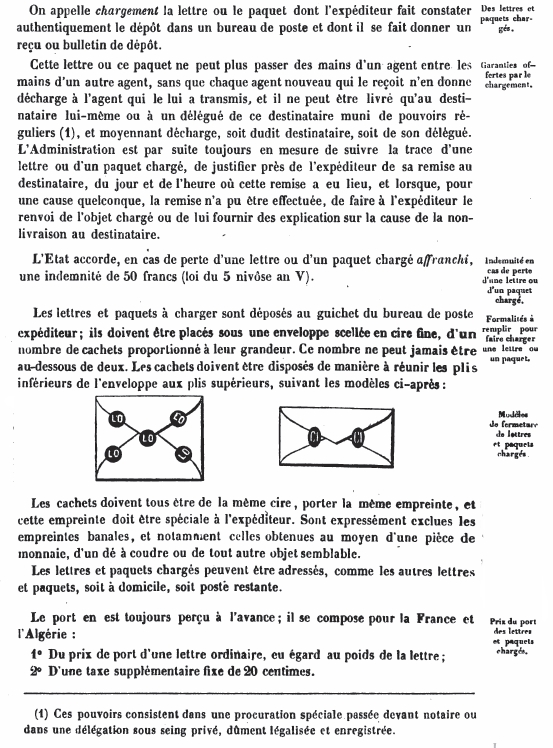
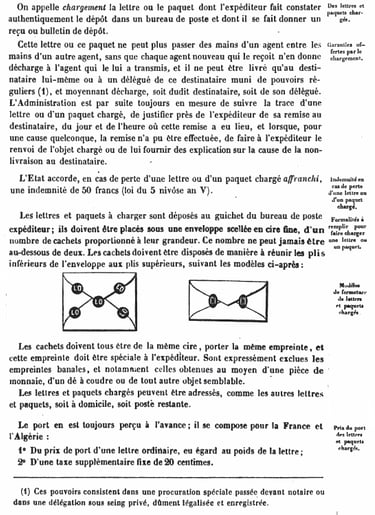

Extract from the 1857 postal directory.
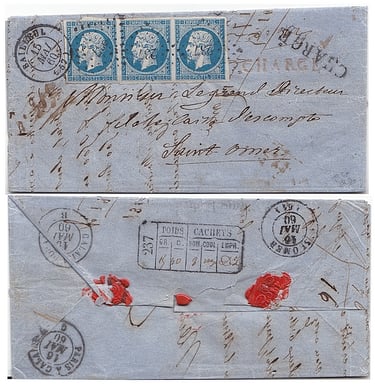
Letter from BAILLEUL to ST OMER franked at 60 c for a weight of 15.4 g, i.e. the 2nd weight step.
The postage breaks down as follows:
40 c postage for the 2nd step;
20 c fixed charge.
(rates of 6 July 1859)
The regulations did not impose a specific number of wax seals. At least 2 were required.
Circular no. 129 of June 1859 did not specify the colour of ink to be used for the Chargé description stamp. However, since circular no. 36 of 18 October 1836, the CHARGE stamp must be applied in red rather than black.
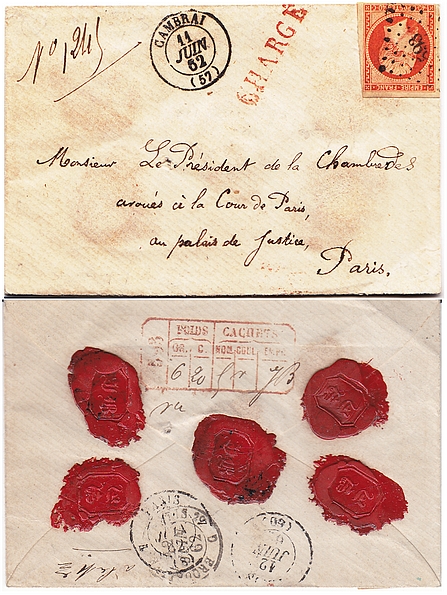
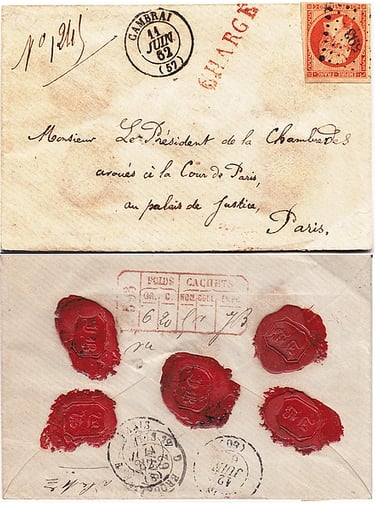
Letter from CAMBRAI to PARIS franked at 40 c for a weight of 6.2g.
The postage is applied as follows:
20 c for postage at the first weight step;
20 c fixed charge.
The number in the top left-hand corner is for registration in register no. 18.
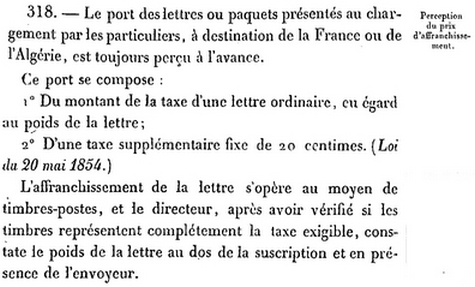
Article 318 of the 1856 General Instruction.
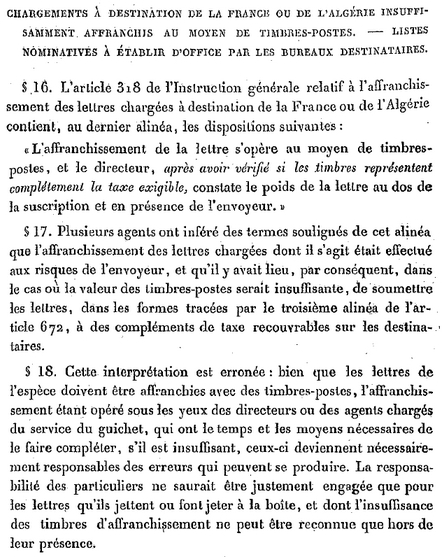
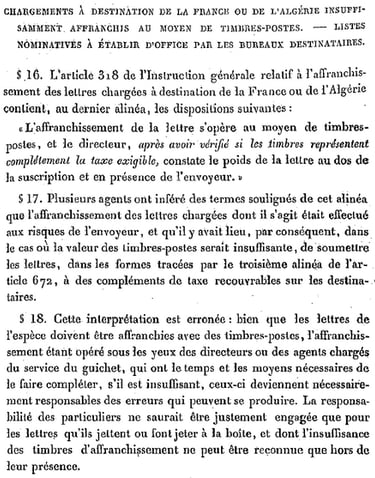
Extract from circular no. 20 of the August 1856 issue of the Monthly Bulletin.
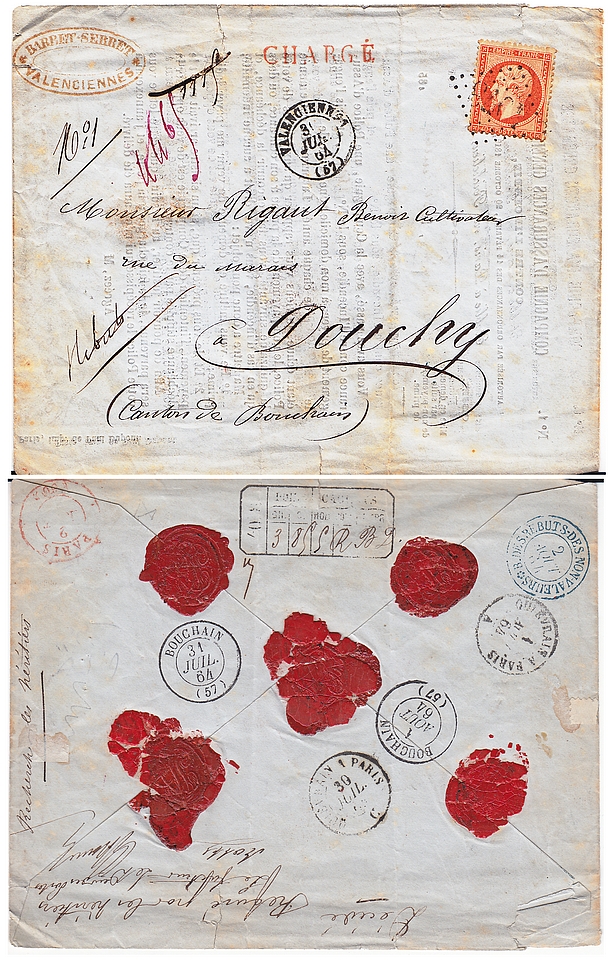
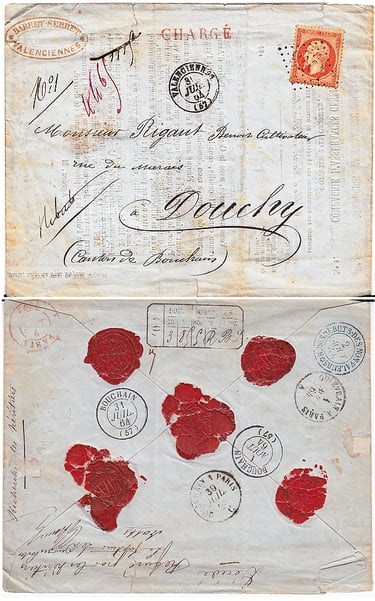
Chargé Letter from VALENCIENNES to DOUCHY (postal district of the BOUCHAIN post office) franked at 40 c.
This letter was addressed to a deceased person and the heirs did not wish to collect it: "Décédé....Refusée par les héritiers".
In such a case, a refused Chargé letter was sent to the dead letter branch in PARIS.
The Chargé order number recorded at VALENCIENNES is crossed out and the BOUCHAIN post office put a new number (1), the one in the list of daily dead letters sent to Paris.
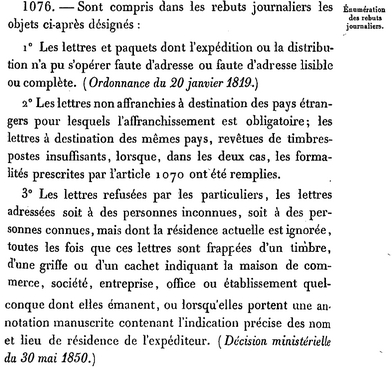
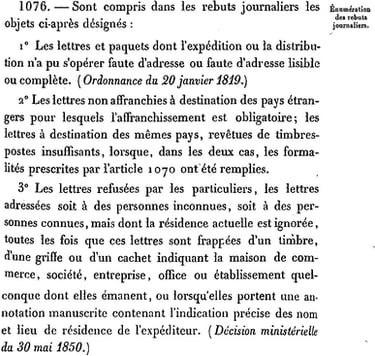
Extract from article 1076 of the 1856 General Instruction.
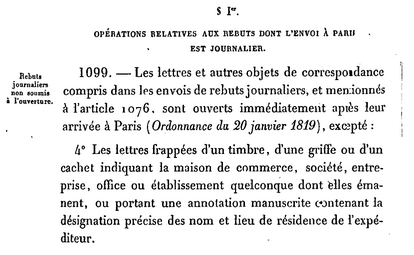
Extract from article 1099 of the General Instruction of 1856.
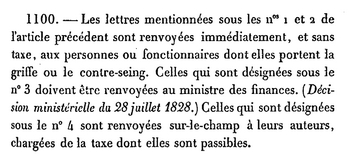
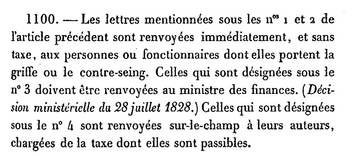
Article 1100 of the General Instruction of 1856.
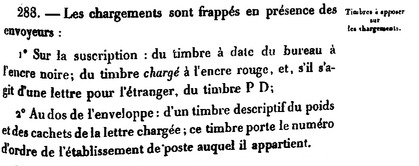
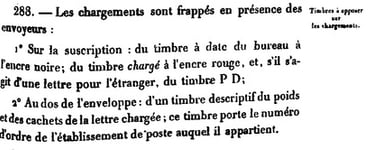
Article 288 of the General Instruction of 1868.
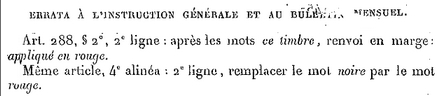
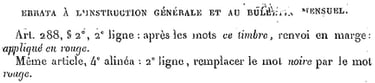
Extract from the errata of Monthly Bulletin no. 2, August 1868.

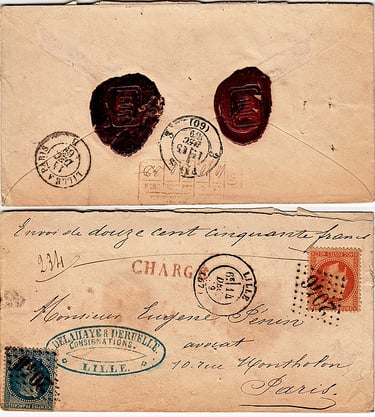
Declared value letter of 1250 fr weighing 10.7 g from LILLE to PARIS. Postage breaks down as follows:
40 centimes for the 2nd weight step;
20 c for fixed charge.
The sender paid 1fr30 proportional fee in cash.
On 1 June 1870, the proportional fee on declared value letters had to be paid in postage stamps rather than in cash.
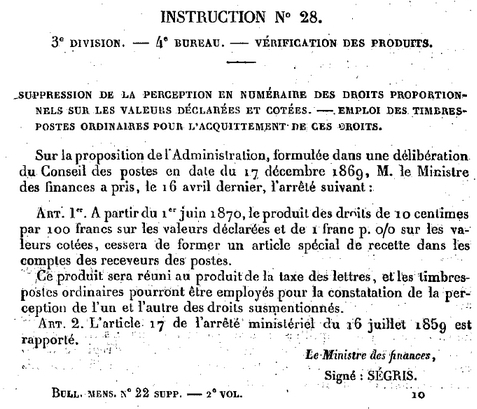
Circular no. 28 of Monthly Bulletin no. 22, April 1870.

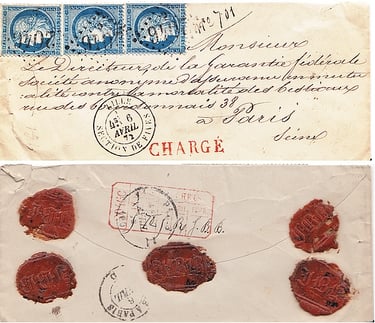
Chargé letter weighing 5.7 g from LILLE-FIVES to PARIS.
Postage at 75 c is calculated as follows:
25 c for the first weight step;
50 c fixed Chargé fee.
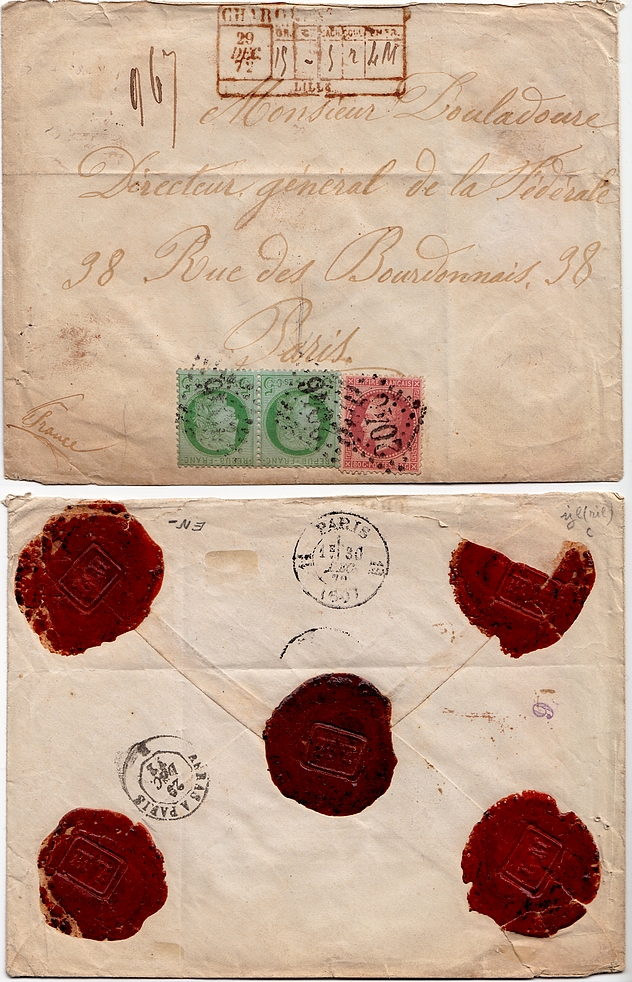
Chargé letter weighing 15 g from LILLE to PARIS.
The franking is as follows:
40 c for 2nd step of weight (more than 10 g);
50 c for registration.
On 1 September 1871, postal rates increased as follows:
- Letters weighing up to 10 g: 25 centimes.
- Over 10 g up to and including 20 g: 40 centimes.
- Over 20 g up to and including 50 g: 70 centimes.
- For each additional 50 g or fraction thereof: an additional 50 centimes.
- Fixed registration fee: 50 centimes.
- Proportional insurance fee per 100 francs of declared value: 20 centimes.
The maximum declared value remained 2,000 francs.
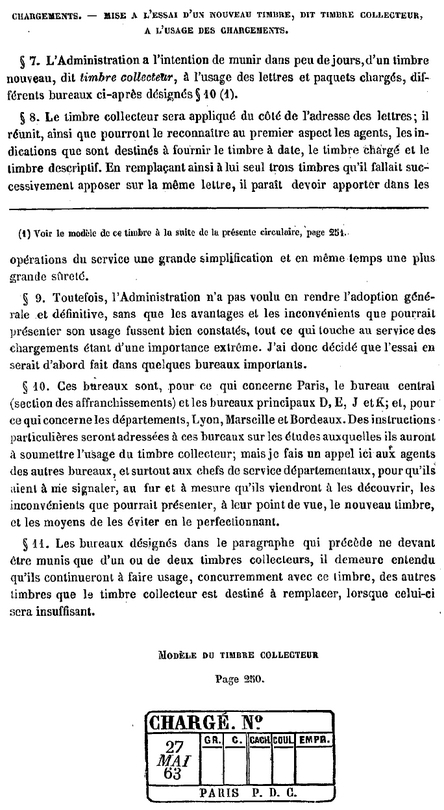
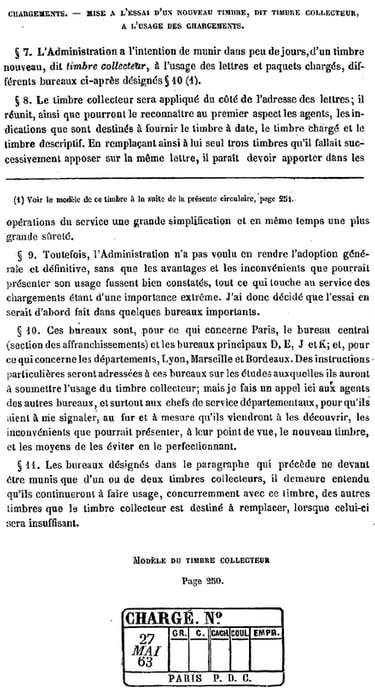
Extract from circular no. 301 in the June 1863 issue of the Monthly Bulletin.
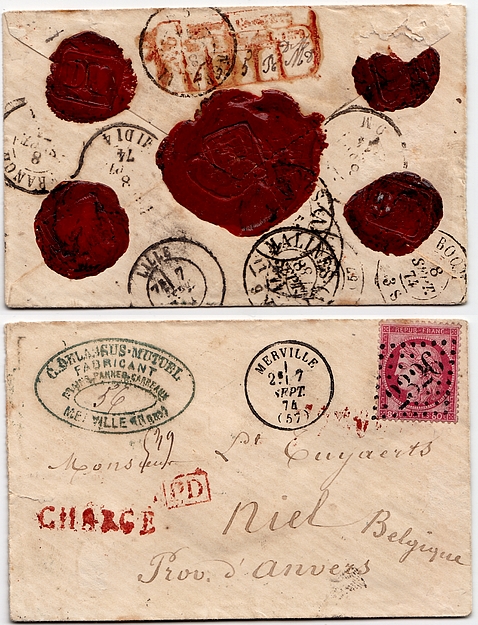
Chargé letter from MERVILLE for NIEL in Belgium franked at 80 c. Chargé letters to Belgium were authorised. Instruction no. 15 of the June 1869 Monthly Bulletin added an amendment to the 1865 French-Belgian postal agreement. This amendment confirmed the fixed Chargé fee at 50 c and set a proportional fee for declared values at 20 c per fraction of 100fr.
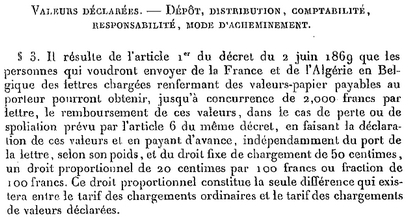
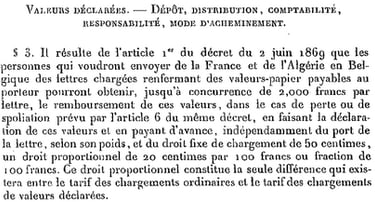
Extract from instruction no. 15 of the June 1869 Monthly Bulletin.
Monthly Bulletin no. 2 of August of the same year rectified this error with an erratum.
The law of 4 June 1859, which came into effect on 6 July 1859, revised the weight steps and allowed customers to enclose valuables in registered letters. Such letters were known as declared-value letters. This service incurred an additional fee of 10 centimes per 100 francs of declared value or fraction thereof. The fee was paid in cash at the post office counter and was not indicated on the letter. The maximum declared value was 2,000 francs.
The weight steps for registered letters were set in June 1859 as follows:
- First weight step — up to and including 10 g: 20 centimes.
- Second weight step — over 10 g up to and including 20 g: 40 centimes.
- Third weight step — over 20 g up to and including 100 g: 80 centimes.
- Above 100 g: an additional 80 centimes for each additional 100 g or fraction thereof.
Although the weight steps changed, the postage rate for each step remained the same.
Until June 1859, registered letters bore only a red CHARGÉ marking in addition to the cancellation and the post office’s datestamp. From 1 July 1859, a new handstamp, recording the registration details, had to be applied to the reverse of each letter. The details entered included the letter’s weight, the number and colour of the wax seals, and the impressions on those seals.

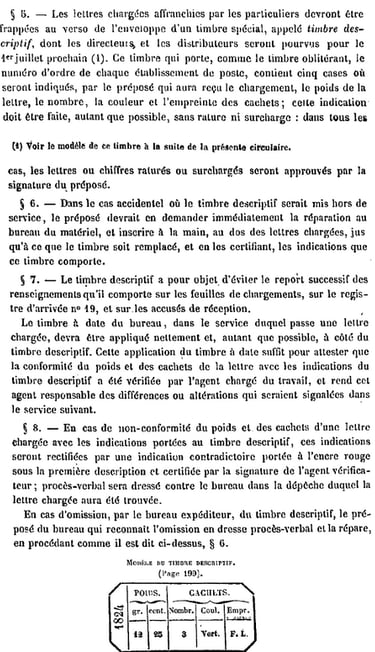
Extract from circular no. 129 in Monthly Bulletin no. 46 of June 1859.
In December 1862, when the postal administration introduced its new numbering system for post offices, the offices were required to exchange their registration-description handstamps according to the new numbering system used for the Large Numeral cancellations.
In February 1873, under the law of 25 January 1873, the maximum declared value was increased to 10,000 francs.
The postal tariff of 1 January 1876 left the registration and declared-value fees unchanged, modifying only the postage rates and weight steps:
- Letters weighing up to and including 15 g: 25 centimes.
- Over 15 g up to and including 30 g: 50 centimes.
- Over 30 g up to and including 50 g: 75 centimes.
- For each additional 50 g or fraction thereof: an additional 50 centimes.
In addition to allowing valuables to be enclosed in registered letters, Circular No. 135 of July 1859 also introduced the option of requesting an acknowledgement of receipt. Senders could obtain this service from the postal service for a fee of 10 centimes.
Acknowledgement-of-receipt forms for registered mail varied in format over time, but invariably consisted of four sheets.
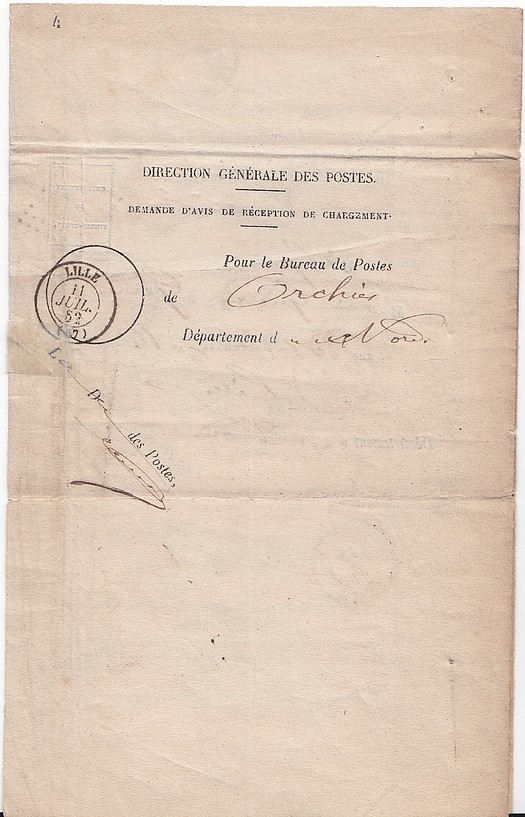
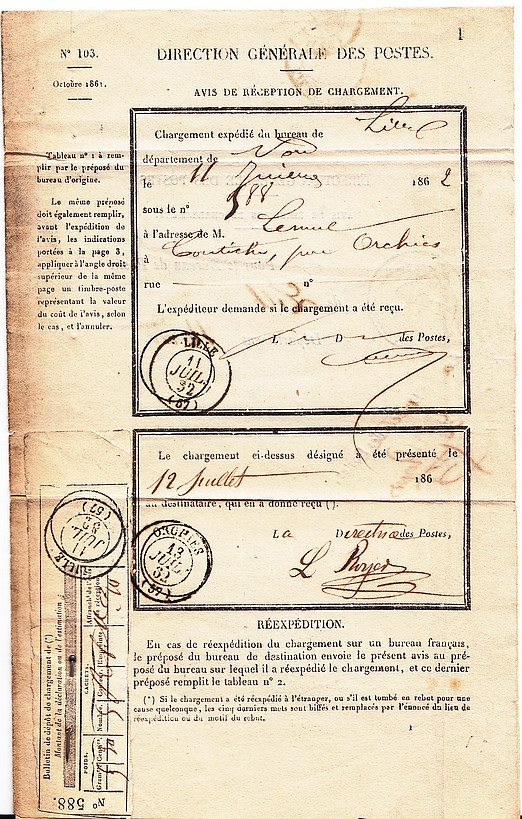
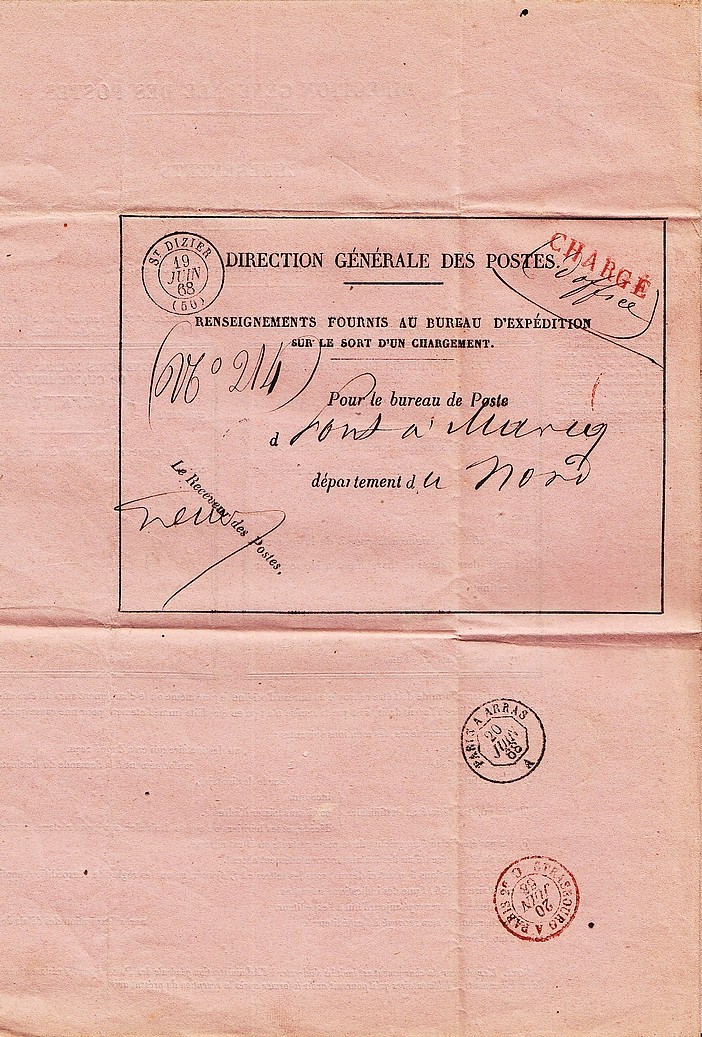
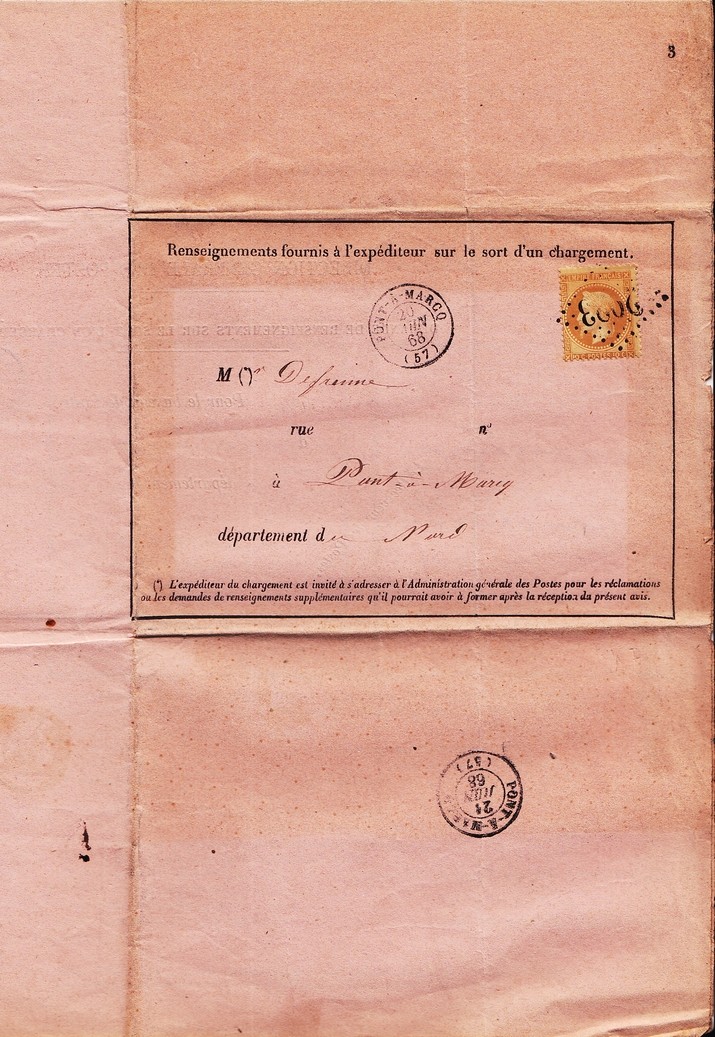
The post office of LILLE has already filled in page 1; the ORCHIES office must fill in page 2 if the letter has been delivered. Note that the sender has filed this notice with the letter deposit receipt.
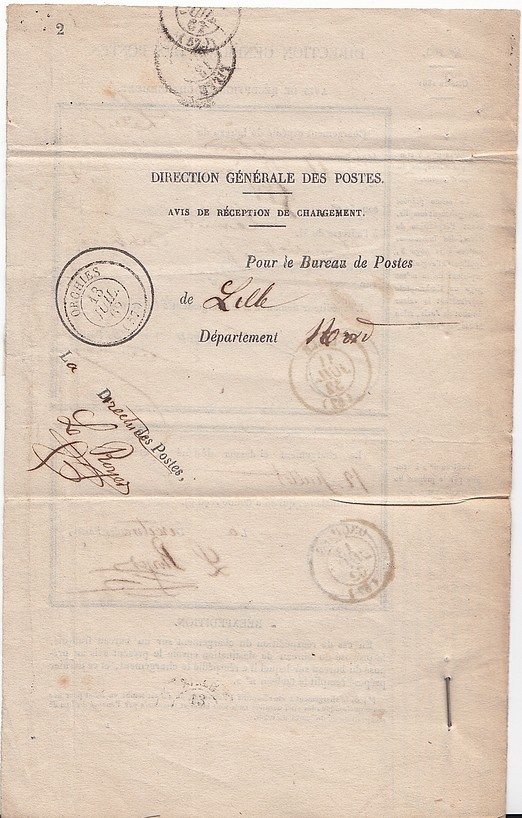
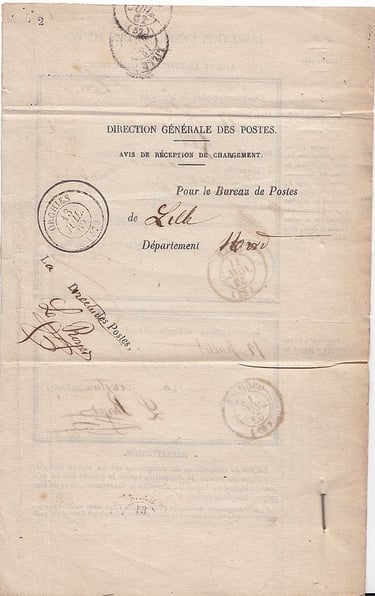
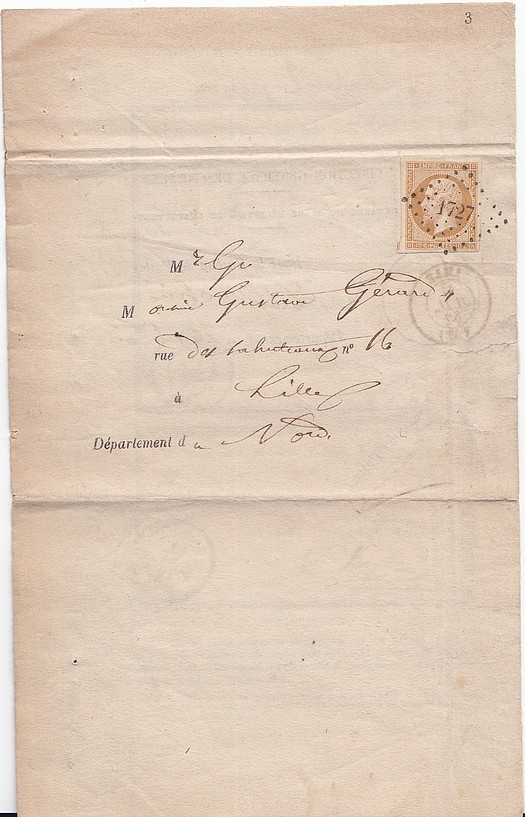
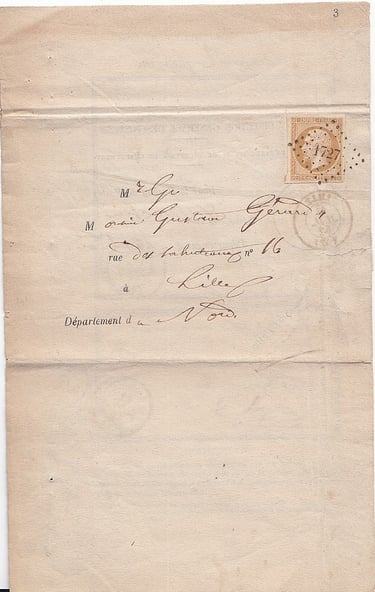
The post office of ORCHIES sent the form to the LILLE post office.
Once received in LILLE, form 103 was sent to the sender. Note that the 10c stamp was affixed and cancelled by the post office of LILLE before the form was sent to ORCHIES.
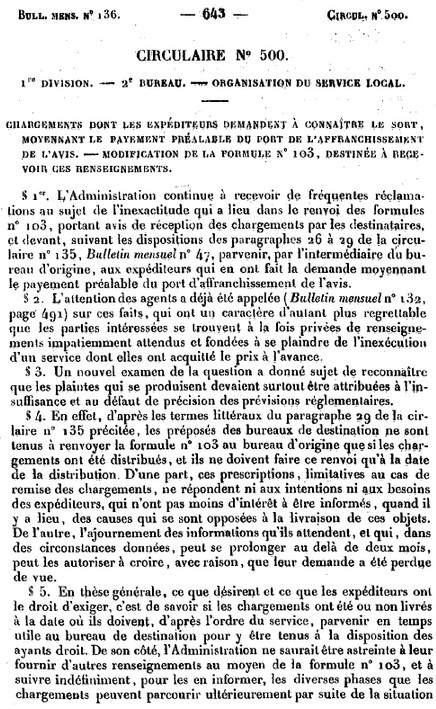
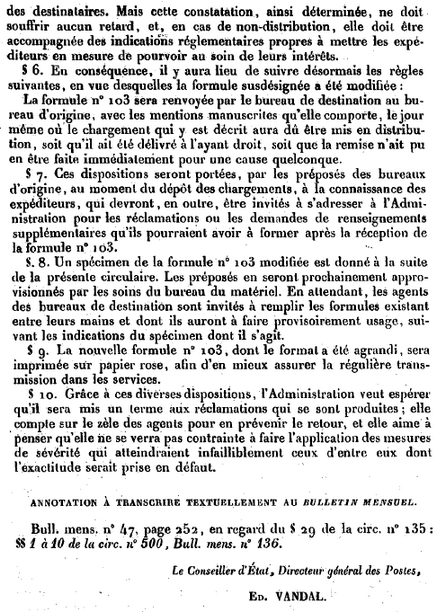
The Administration recognised that Form No. 103 was not always completed correctly by postal agents and lacked sufficient detail. As a result, a new version of Form No. 103 was introduced in March 1867. This decision was officially announced in Circular No. 500, published in the Monthly Bulletin of December 1866.
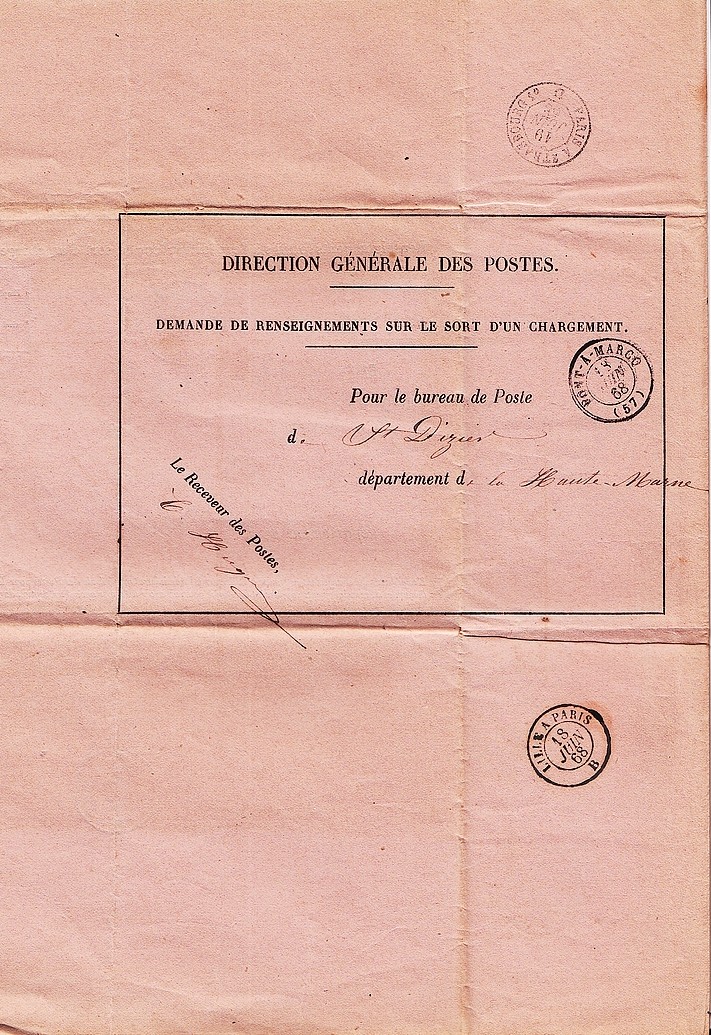
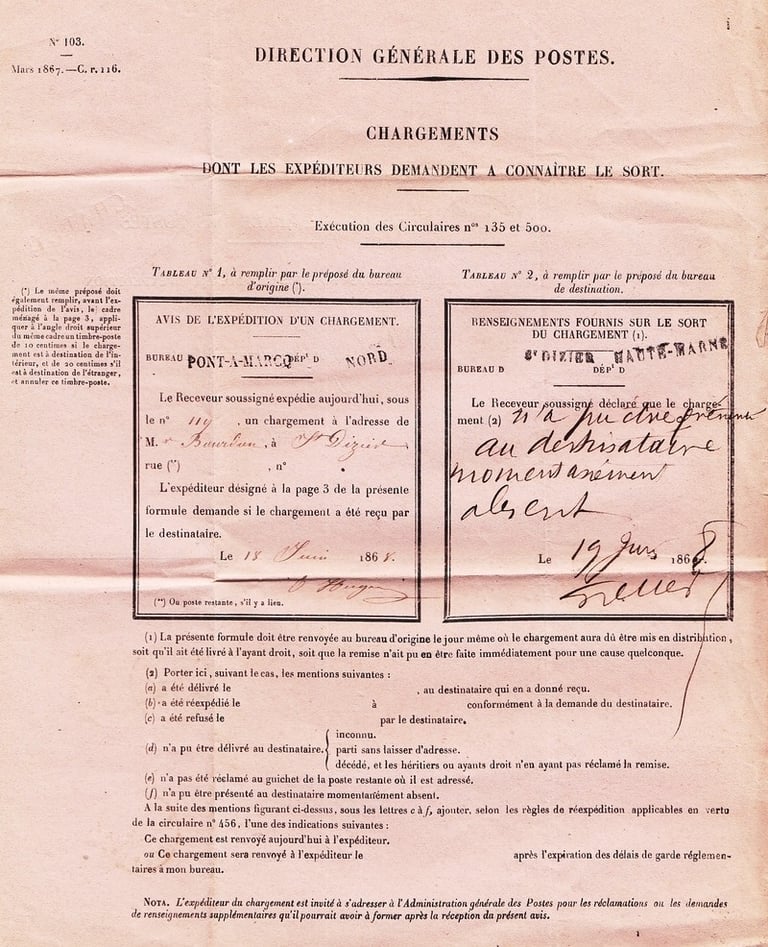
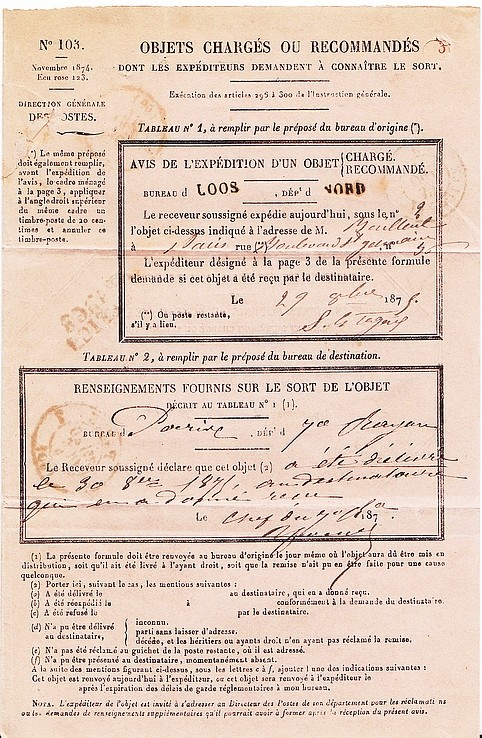

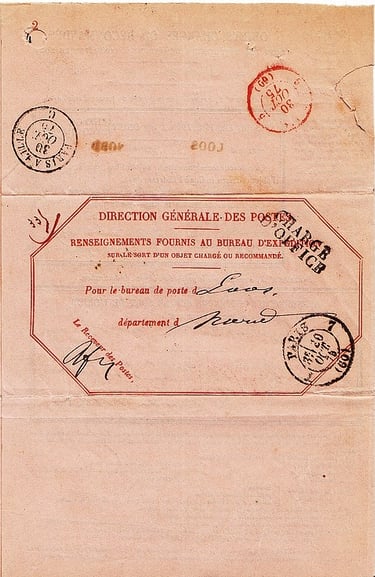
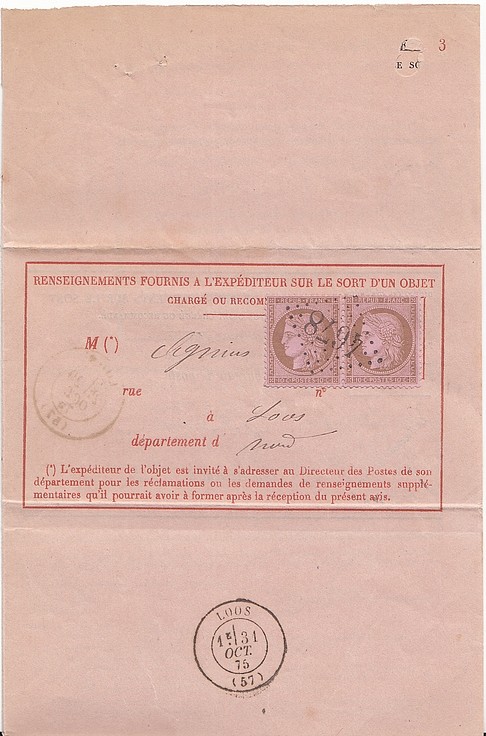
English translation:
A letter or parcel is said to be charged when its sender has its deposit at a post office officially recorded and receives a receipt or certificate of posting.
Such a letter or parcel may only pass from the hands of one postal employee to those of another after the latter has acknowledged receipt by issuing a new discharge to the employee handing it over. It may only be delivered to the addressee in person or to a representative duly authorised by the addressee (1), against a signed receipt from the addressee or their representative. and only against a signed receipt from the addressee or their representative.
The Postal Administration is therefore always able to trace a charged letter or parcel, establish, on the basis of the sender's proof of posting, the date and time at which it was delivered to the addressee and, if delivery has not taken place for any reason, inform the sender of its return or explain why it was not delivered.
In the event of the loss of a prepaid charged letter or parcel, the State grants compensation of 50 francs (Law of 5 Nivôse, Year V).
Letters and parcels to be sent under the charged-mail procedure must be handed in at the counter of the post office of origin.
They must be enclosed in an envelope sealed with wax, bearing five seals, proportionate in size to the envelope. The number of seals may never exceed two.
The seals must be arranged so as to join the lower folds of the envelope to the upper folds, as shown in the illustrations below.
All seals must be made of the same wax, bear the same impression, and that impression must be specific to the sender. Common impressions, particularly those made using a coin, the back of a thimble, or any other similar object, are expressly excluded.
Charged letters and parcels may be addressed, like ordinary letters and parcels, either for delivery to the addressee's residence or for collection at the post office (poste restante).
Postage must always be paid in advance. For France and Algeria, it consists of:
The ordinary letter postage, according to the weight of the letter.
An additional fixed charge of 20 centimes.
(1) Such authorisation must take the form of a special power of attorney executed before a notary, or a privately executed authorisation duly legalised and registered.
English translation:
§ 5. Charged letters sent with postage prepaid by private individuals must bear, on the back of the envelope, a special handstamp known as the descriptive handstamp. Postmasters and postal distributors will be supplied with this handstamp by next 1 July (1).
Like the cancelling handstamp, it bears the identification number of each post office and contains five spaces in which the postal employee accepting the charged letter must enter its weight, the number of wax seals, and the colour and impression of those seals.
These details must, as far as possible, be entered without erasures or alterations. In all cases, any figures that have been crossed out or overwritten must be authenticated by the signature of the postal employee.
(1) See the illustration of this handstamp following the present circular.
§ 6. If the descriptive handstamp should accidentally become unusable, the postal employee must immediately request its repair from the Equipment Office and, until it has been replaced, enter by hand on the back of charged letters the information normally contained in the handstamp, certifying these details.
§ 7. The purpose of the descriptive handstamp is to eliminate the need to repeatedly record the information it contains on the accompanying charged-mail sheets, in Arrival Register No. 19, and on the acknowledgements of receipt.
The datestamp of each post office through which a charged letter passes must be applied clearly and, as far as possible, alongside the descriptive handstamp.
The application of the datestamp is sufficient to certify that the weight and wax seals of the letter have been checked against the information recorded in the descriptive handstamp by the postal employee responsible for handling the charged letter.
It also makes that employee responsible for any discrepancies or alterations reported at a subsequent stage of transmission.
§ 8. If the weight or wax seals of a charged letter do not correspond to the information recorded in the descriptive handstamp, the discrepancies must be corrected by means of a contradictory annotation written in red ink beneath the original description and certified by the signature of the employee carrying out the verification.
An official report must also be drawn up against the post office in whose dispatch the charged letter was found.
If the post office of origin has omitted to apply the descriptive handstamp, the employee at the office where the omission is discovered must draw up an official report and rectify the omission, following the procedure described above in § 6.
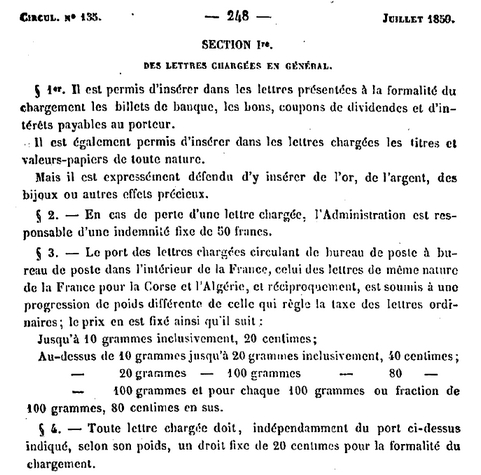
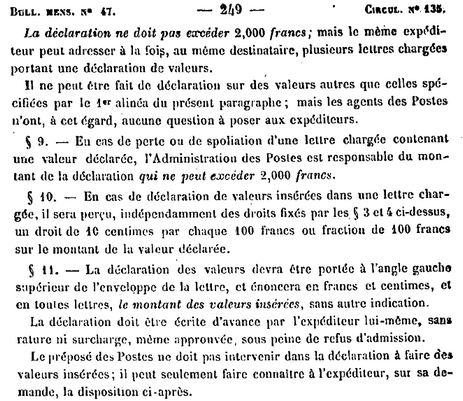
English translation: Circular No. 135 — July 1859
§ 1. Banknotes, bonds, dividend coupons and interest coupons payable to bearer may be enclosed in letters submitted under the charged-mail procedure.
Securities and paper valuables of all kinds may also be enclosed in charged letters.
However, the enclosure of gold, silver, jewellery or other precious articles is expressly prohibited.
§ 2. In the event of the loss of a charged letter, the Postal Administration is liable for a fixed compensation of 50 francs.
§ 3. The postage for charged letters sent from one post office to another within mainland France, between mainland France and Corsica or Algeria, and vice versa, is calculated according to a weight scale different from that applicable to ordinary letters.
The rates are as follows:
Up to and including 10 grams: 20 centimes.
Over 10 grams and up to and including 20 grams: 40 centimes.
Over 20 grams and up to and including 100 grams: 80 centimes.
Over 100 grams: 80 centimes, plus 80 centimes for each additional 100 grams or fraction thereof.
§ 4. Every charged letter is subject, in addition to the postage calculated according to its weight as specified above, to a fixed charge of 20 centimes for the charged-mail procedure.
§ 8. Extract
The declared value must not exceed 2,000 francs. However, the same sender may send several charged letters containing declared values to the same addressee at the same time.
A declaration of value may only concern the valuables specified in § 1, paragraph 1, above. Postal employees are not required to question senders on this matter.
§ 9. In the event of the loss of, or damage to, a charged letter containing a declared value, the Postal Administration is liable for compensation equal to the declared amount, which may not exceed 2,000 francs.
§ 10. When a declaration is made concerning valuables enclosed in a charged letter, an additional charge of 10 centimes for every 100 francs, or fraction of 100 francs, of the declared value shall be payable, independently of the charges specified in § 3 and the preceding provisions.
§ 11. The declaration of value must be written in the upper left-hand corner of the envelope, in francs and centimes, and must state only the amount of the valuables enclosed.
The declaration must be written in advance by the sender personally, without erasures or alterations, even if initialled. Otherwise, the letter shall be refused.
Postal employees must not take part in preparing the declaration of value. They may only, at the sender's request, inform the sender of the requirements set out above.
English translation:
318. Postage on letters or parcels submitted for the charged-mail service by private individuals, addressed to destinations in France or Algeria, must always be paid in advance.
This postage consists of:
The ordinary letter postage, calculated according to the weight of the letter.
An additional fixed charge of 20 centimes. (Law of 20 May 1854.)
The postmaster shall affix the postage stamps to the letter after verifying that they fully cover the required postage. The postmaster shall then record the weight of the letter on the back of the address side, in the presence of the sender.
English translation:
CHARGED LETTERS ADDRESSED TO FRANCE OR ALGERIA INSUFFICIENTLY PREPAID WITH POSTAGE STAMPS — LISTS OF ADDRESSEES TO BE DRAWN UP BY THE POST OFFICES OF DESTINATION
§ 16. Article 318 of the General Postal Instructions, concerning the prepayment of postage on charged letters addressed to France or Algeria, contains the following provisions in its final paragraph:
“The letter is prepaid by means of postage stamps, and the postmaster, after verifying that the stamps fully cover the required postage, records the weight of the letter on the reverse of the address panel, in the presence of the sender.”
§ 17. Several postal employees have inferred from the underlined words in this paragraph that the prepayment of postage on the charged letters concerned was carried out at the sender's risk and that, consequently, where the value of the postage stamps was insufficient, the letters should be subjected, in accordance with the procedure laid down in the third paragraph of Article 672, to additional postage charges recoverable from the addressees.
§ 18. This interpretation is incorrect. Although letters of this kind must be prepaid by means of postage stamps, the prepayment is carried out under the supervision of postmasters or postal employees responsible for counter services. Since these employees have the time and means necessary to ensure that the postage is fully paid, they necessarily become responsible for any errors that may occur.
Private individuals can justifiably be held responsible only for letters that they post, or have posted, in a letterbox, where insufficient postage cannot be detected in their presence.
English translation:
1076. The following items shall be classified as daily undeliverable mail:
1. Letters and parcels that could not be forwarded or delivered because the address was missing, illegible or incomplete.
(Ordinance of 20 January 1819.)
2. Unpaid letters addressed to foreign countries for which prepayment of postage is compulsory, and letters addressed to those same countries bearing insufficient postage stamps, provided that, in both cases, the formalities prescribed by Article 1070 have been completed.
3. Letters refused by private individuals, and letters addressed either to unknown persons or to persons whose identities are known but whose current places of residence are unknown, whenever such letters bear a postmark, a stamped mark or a cachet identifying the commercial firm, company, business, office or other establishment from which they originate, or when they bear a handwritten annotation precisely stating the sender's name and place of residence. (Ministerial Decision of 30 May 1850.)
English translation:
SECTION I — PROCEDURES RELATING TO UNDELIVERABLE MAIL SENT DAILY TO PARIS
1099. Letters and other items of correspondence included in the daily consignments of undeliverable mail, as referred to in Article 1076, shall be opened immediately upon their arrival in Paris (Ordinance of 20 January 1819), with the following exception:
4. Letters bearing a postmark, a stamped mark or a cachet identifying the commercial firm, company, business, office or other establishment from which they originate, or bearing a handwritten annotation precisely stating the sender's name and place of residence.
English translation:
1100. The letters referred to under Nos. 1 and 2 of the preceding article shall be returned immediately, free of charge, to the persons or officials whose identifying handstamp or countersignature they bear.
Those referred to under No. 3 must be returned to the Minister of Finance. (Ministerial Decision of 28 July 1828.)
Those referred to under No. 4 shall be returned without delay to their senders, subject to the postage due on them.
English translation:
288. Charged letters and parcels shall be stamped in the presence of the senders as follows:
1. On the address side:
The dated postmark of the post office, applied in black ink.
The word chargé (“registered”) applied in red ink.
For letters addressed abroad, the P.D. handstamp.
2. On the reverse of the envelope:
A descriptive handstamp indicating the weight and wax seals of the charged letter. This handstamp bears the identification number of the post office to which it belongs.
English translation:
ERRATA TO THE GENERAL POSTAL INSTRUCTIONS AND MONTHLY BULLETIN
Article 288, § 2, second line: After the words “this handstamp”, add the following marginal note: “applied in red ink.”
Same article, fourth paragraph, second line: Replace the word “black” with “red.”
English translation:
INSTRUCTION No. 28
3rd Division — 4th Office — Verification of Revenue
ABOLITION OF CASH COLLECTION OF PROPORTIONAL CHARGES ON DECLARED VALUES AND INSURED ITEMS — USE OF ORDINARY POSTAGE STAMPS FOR PAYMENT OF THESE CHARGES
Following a proposal by the Postal Administration, set out in a resolution of the Postal Council dated 17 December 1869, the Minister of Finance issued the following order on 16 April:
Article 1. From 1 June 1870, the proceeds of the charge of 10 centimes per 100 francs on declared values and of 1 franc per 1,000 francs on insured items shall cease to constitute a separate revenue item in the post offices' revenue accounts.
These proceeds shall be combined with revenue from letter postage, and ordinary postage stamps may be used to record the collection of either of the two aforementioned charges.
Article 2. Article 17 of the Ministerial Order of 6 July 1859 is hereby repealed.
The Minister of Finance,
Signed: SÉGRIS.
English translation:
CHARGED MAIL — TRIAL INTRODUCTION OF A NEW HANDSTAMP, KNOWN AS THE TIMBRE COLLECTEUR, FOR USE ON CHARGED LETTERS AND PARCELS
§ 7. The Postal Administration intends, within the next few days, to supply the various post offices designated below in § 10 with a new handstamp, known as the timbre collecteur (combined handstamp), for use on charged letters and parcels (1).
§ 8. The combined handstamp shall be applied to the address side of letters. It will combine, in a form that postal employees will immediately recognise, the information previously provided by the dated postmark, the CHARGÉ handstamp and the descriptive handstamp.
By replacing these three handstamps, which previously had to be applied successively to the same letter, it should considerably simplify postal operations while providing greater security.
(1) See the illustration of this handstamp following the present circular, page 281.
§ 9. However, the Postal Administration has not wished to introduce its use generally and definitively before its advantages and any disadvantages have been properly assessed, since the charged-mail service is of particular importance.
It has therefore been decided that the new handstamp shall initially be tested in a number of major post offices.
§ 10. The offices selected for this trial are, in Paris, the Central Post Office (Posting Section) and the principal post offices D, E, J and K; and, in the departments, Lyon, Marseille and Bordeaux.
Specific instructions will be sent to these offices regarding the trials to which the combined handstamp is to be subjected.
The Postal Administration also invites employees at other post offices, particularly departmental senior officials, to report any disadvantages that the new handstamp might present, from their point of view, and to suggest ways of avoiding them or improving its design.
§ 11. As the offices designated in the preceding paragraph will
English translation:
DECLARED VALUES — POSTING, DELIVERY, ACCOUNTING, LIABILITY AND FORWARDING PROCEDURES
§ 3. Under Article 1 of the Decree of 2 June 1869, persons wishing to send, from France or Algeria to Belgium, charged letters containing securities payable to bearer may obtain compensation for the loss of, or damage to, these securities, up to a maximum of 2,000 francs per letter, as provided for in Article 6 of the same decree.
To obtain this protection, they must declare the value of the securities and pay in advance, in addition to the postage calculated according to the weight of the letter and the fixed charge of 50 centimes for the charged-mail service, a proportional charge of 20 centimes for every 100 francs of declared value, or fraction thereof.
This proportional charge constitutes the only difference between the rates applicable to ordinary charged letters and those applicable to charged letters containing declared values.
The form may be different, but the process has not changed.
English translation:
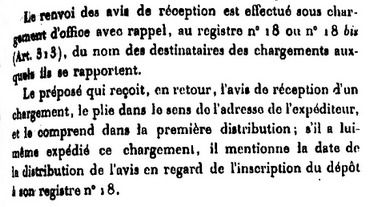
Acknowledgements of receipt shall be returned under the official charged-mail procedure (chargement d'office), with a reference in Register No. 18 or No. 18 bis (Article 313) to the names of the addressees of the charged letters to which they relate.
Upon receiving the returned acknowledgement of receipt for a charged letter, the postal employee shall fold it so that the sender's address is displayed and include it in the first delivery round. If the employee originally dispatched the charged letter, they shall record the date on which the acknowledgement was delivered alongside the corresponding posting entry in Register No. 18.
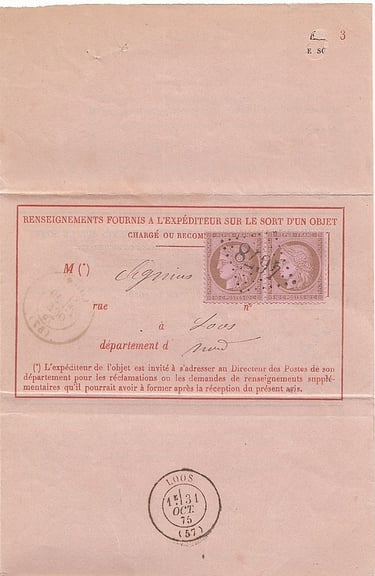
The tariff of 1st September 1871 raised the price of advice no. 103 to 20c. From February 1873 it was also used for registered letters.
Article 294 of the 1868 General Instruction specifies that advice of delivery no. 103 must be Chargé too.
To learn more about French postal rates ?
To find out about French postal rates without necessarily having to consult postal regulations: les tarifs postaux français by Jean-Louis Bourgouin.
English translation:
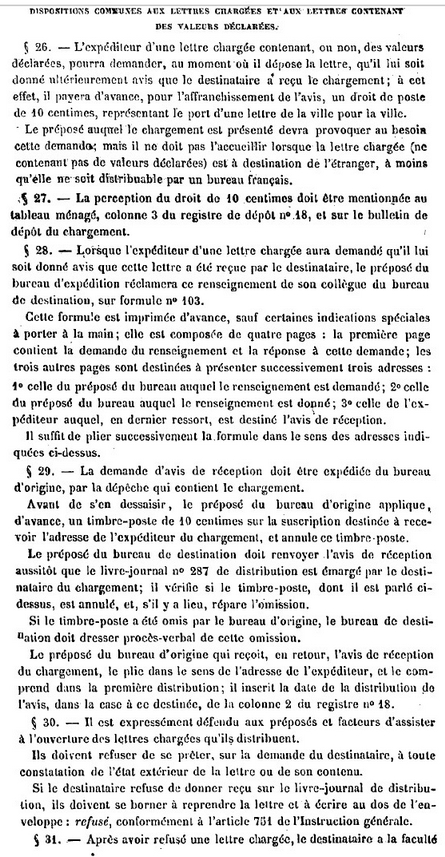
PROVISIONS COMMON TO CHARGED LETTERS AND LETTERS CONTAINING DECLARED VALUES
§ 26. The sender of a charged letter, whether or not it contains declared values, may request, at the time of posting, to be subsequently notified that the addressee has received the letter. For this purpose, the sender shall pay in advance a postal charge of 10 centimes, equivalent to the postage for a letter sent within the same town.
The postal employee to whom the charged letter is presented must inform the sender of this option. However, the employee must not accept such a request when the charged letter (whether or not it contains declared values) is addressed abroad, unless it is to be delivered by a French post office.
§ 27. Collection of the 10-centime charge must be recorded in the appropriate column, column 3, of Posting Register No. 18 and on the receipt issued for the charged letter.
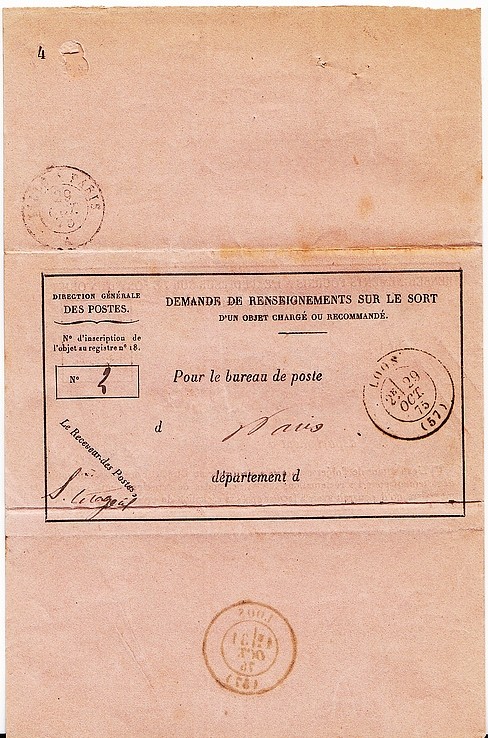
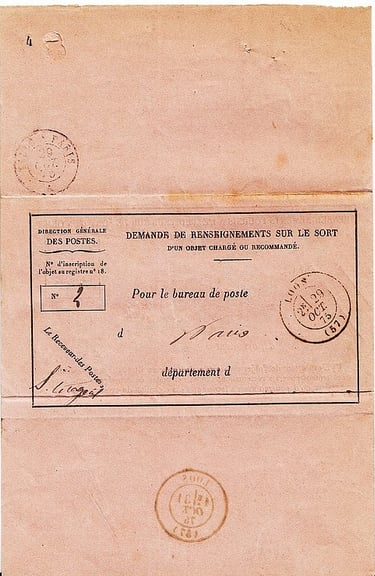
§ 28. When the sender of a charged letter has requested notification that the letter has been received by the addressee, the postal employee at the office of origin shall request this information from their counterpart at the office of destination, using Form No. 103.
This form is printed in advance, except for certain details that must be entered by hand. It consists of four pages: the first contains the request for information and the reply to that request; the other three are intended to bear three successive addresses:
That of the postal employee at the office from which the information is requested.
That of the postal employee at the office providing the information.
That of the sender to whom the acknowledgement of receipt is ultimately addressed.
The form need only be folded successively so that the appropriate address is displayed.
§ 29. The request for an acknowledgement of receipt must be sent from the office of origin by the dispatch containing the charged letter.
Before sending it, the postal employee at the office of origin shall affix a 10-centime postage stamp to the address panel intended to receive the sender's address and cancel the stamp.
The postal employee at the office of destination must return the acknowledgement of receipt as soon as the addressee has signed for the charged letter in Distribution Register No. 287. The employee shall verify that the postage stamp referred to above is present and, if necessary, correct the omission.
If the postage stamp has been omitted by the office of origin, the office of destination must draw up an official report recording the omission.
On receiving the returned acknowledgement of receipt, the postal employee at the office of origin shall fold it so that the sender's address is displayed, include it in the first delivery round, and enter the date of delivery of the acknowledgement, where applicable, in column 2 of Register No. 18.
§ 30. Postal employees are expressly forbidden to assist in opening the charged letters they deliver.
They must refuse to carry out, at the addressee's request, any examination of the external condition of the letter or its contents.
If the addressee refuses to sign the distribution register, the employees must take back the letter and write the word refusé (“refused”) on the back of the envelope, in accordance with Article 751 of the General Postal Instructions.
English translation:
CIRCULAR No. 500
1st Division — 2nd Office — Organisation of the Local Postal Service
CHARGED LETTERS FOR WHICH SENDERS REQUEST NOTIFICATION OF DELIVERY, SUBJECT TO PREPAYMENT OF POSTAGE FOR THE ACKNOWLEDGEMENT OF RECEIPT — MODIFICATION OF FORM No. 103 USED TO RECORD THIS INFORMATION
§ 1. The Postal Administration continues to receive frequent complaints concerning the delays in returning Form No. 103, which serves as an acknowledgement of receipt for charged letters delivered to their addressees. Under the provisions of paragraphs 26 to 29 of Circular No. 135, published in Monthly Bulletin No. 47, these forms must be forwarded, through the post office of origin, to senders who have requested them and prepaid the postage for the acknowledgement of receipt.
§ 2. The attention of postal employees has already been drawn (Monthly Bulletin No. 132, page 491) to these circumstances, which are particularly regrettable because the parties concerned are simultaneously deprived of information they are impatiently awaiting and led to complain about the failure to provide a service for which they have paid in advance.
§ 3. A further examination of the matter has shown that these complaints must be attributed mainly to the inadequacy and lack of precision of the existing regulations.
§ 4. Indeed, according to the literal wording of paragraph 29 of the aforementioned Circular No. 135, employees at post offices of destination are required to return Form No. 103 to the office of origin only after the charged letters have been delivered. These provisions, by restricting the return of the forms to cases in which delivery has taken place, do not meet either the intentions or the needs of senders, who have no less interest in being informed when circumstances prevent delivery of their letters.
Furthermore, the postponement of the information they are awaiting, which may, in certain circumstances, extend beyond two months, may reasonably lead them to believe that their request has been overlooked.
§ 5. As a general rule, what senders wish to know, and what they are entitled to require, is whether their charged letters have or have not been delivered by the date on which they should have been delivered in the normal course of the postal service. This information must reach the post office of destination in sufficient time to be made available to the parties concerned.
For its part, the Postal Administration cannot be required to provide them with further information by means of Form No. 103, nor to continue indefinitely reporting the various stages through which charged letters may subsequently pass as a result of circumstances affecting their addressees.
However, the information provided in this way, even when definitive, must not be subject to any delay. In cases of non-delivery, it must also be accompanied by the prescribed information enabling senders to safeguard their interests.
§ 6. Consequently, the following rules shall henceforth apply, and Form No. 103 has been modified accordingly:
Form No. 103 shall be returned by the post office of destination to the office of origin, with handwritten particulars indicating the very day on which the charged letter to which it relates should have been delivered, either that it has been delivered to the rightful addressee or that delivery could not take place for any reason whatsoever.
§ 7. These provisions shall be brought to the attention of senders by postal employees at offices of origin when charged letters are posted. These employees must also be invited to inform the Postal Administration of any complaints or requests for additional information that senders may wish to make upon receiving Form No. 103.
§ 8. A specimen of the modified Form No. 103 is reproduced following this circular. Postal employees will shortly receive supplies through the Equipment Office.
In the meantime, employees at post offices of destination are requested to use the existing forms available to them, making temporary use of them in accordance with the instructions provided by the specimen.
§ 9. The new Form No. 103, whose format has been enlarged, shall be printed on pink paper in order to facilitate its regular transmission through the postal service.
§ 10. By means of these various provisions, the Postal Administration hopes to put an end to the complaints that have arisen. It relies on the diligence of its employees to take the greatest care in implementing these measures, which will naturally benefit both senders and those whose punctuality has been called into question
The Councillor of State, Director-General of Posts
Ed. VANDAL
The General Instruction published in July 1868 failed to mention the colour of the ink reserved for the Chargé description stamp.
More Postal Stories to explore


Inscription of tax figures


