


19th Century French Postal Fraud
Since the introduction of the postage stamp and throughout the 19th century, the Post Office remained vigilant against the risk of stamp reuse. At the time, the Post Office operated under the authority of the Ministry of Finance, meaning postal fraud could result in significant revenue losses for the State. To combat this issue, authorities implemented various technical measures—such as stamp cancellation methods and specialized printing inks—as well as legal deterrents, since postal fraud was classified as a criminal offence.
Numeral cancels played a crucial role in detecting reused stamps. It was relatively easy to verify whether the date stamp from the originating post office corresponded with the numeral cancel, helping to identify fraudulent reuse.
Anyone caught reusing a cancelled postage stamp faced prosecution in a criminal court.
To contextualize the following documents, I have included articles from the 1856 General Instruction on Postal Services, a manual that served as the definitive reference for postal agents at the time.
The file does not include the sealed envelope (model 1198), which is expected, as it was only intended for temporary retention.
At the same time, a Notice of Issue for a letter bearing a presumed fraudulent postage stamp (model 1197) was sent in duplicate—one copy to the Administration in PARIS and the other to the Departmental Postal Inspector in LILLE.
In ORCHIES, the sealed envelope was received with all the precautions required by procedure.
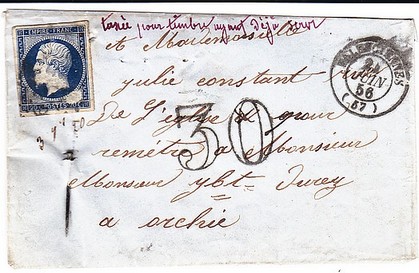
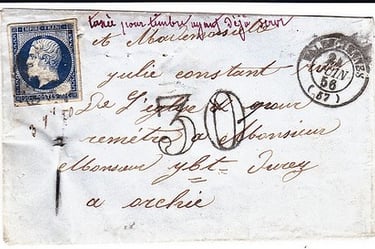
Letter from VALENCIENNES to ORCHIES, dated 24 June 1856.
Upon inspection, the postal workers in VALENCIENNES noticed that the stamp bore traces of a previous cancellation. As a result, they marked it "taxée pour timbre ayant déjà servi" ("taxed for stamp already used"). The letter was subsequently treated as unfranked and taxed accordingly.
The letter was sent in a sealed envelope to the ORCHIES post office.


English transaltion:
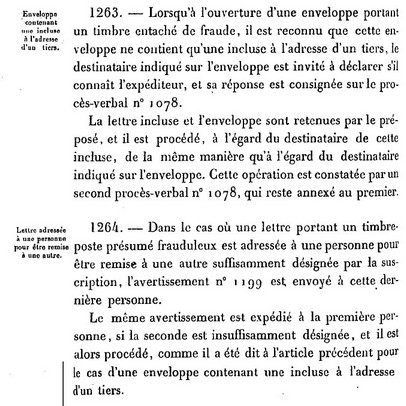
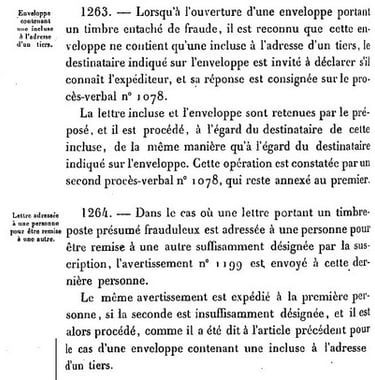
1263. When, upon opening an envelope bearing a postage stamp involved in fraud, it is found that the envelope contains only a letter addressed to a third party, the addressee named on the envelope shall be asked whether they know the sender, and their reply shall be recorded in official report No. 1078.
The enclosed letter and the envelope shall be retained by the postal official, and the same procedure shall be followed with regard to the addressee of the enclosed letter as with regard to the addressee named on the envelope.
This procedure shall be recorded in a second official report, No. 1078, which shall remain attached to the first.
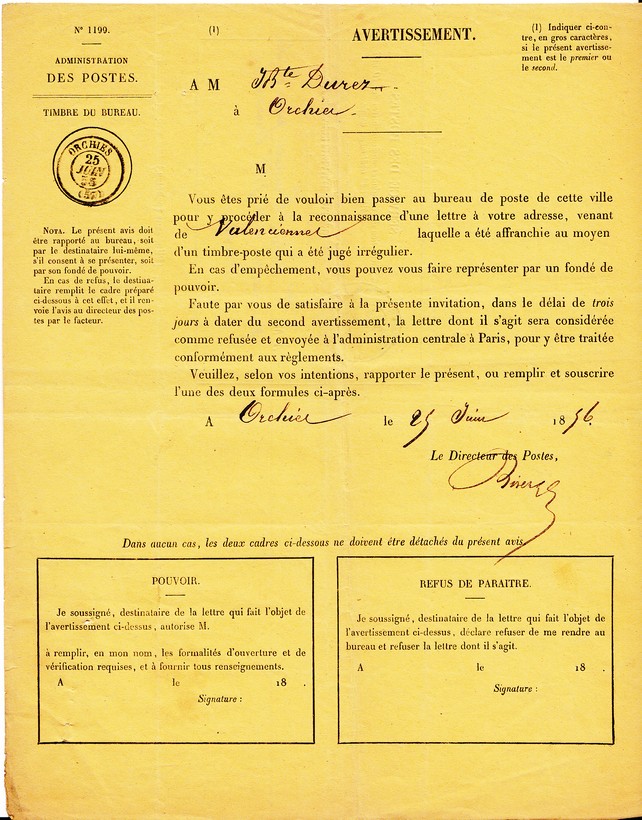
1264. Where a letter bearing a postage stamp suspected of fraud is addressed to one person for delivery to another person sufficiently identified by the address, Notice No. 1199 shall be sent to the latter.
The same notice shall be sent to the first person if the second is not sufficiently identified. The procedure described in the preceding article, concerning an envelope containing a letter addressed to a third party, shall then be followed.
Mr Durez, a company courier by profession, agreed to come to the post office that very day. At the post office, he was expected to fill in a report.
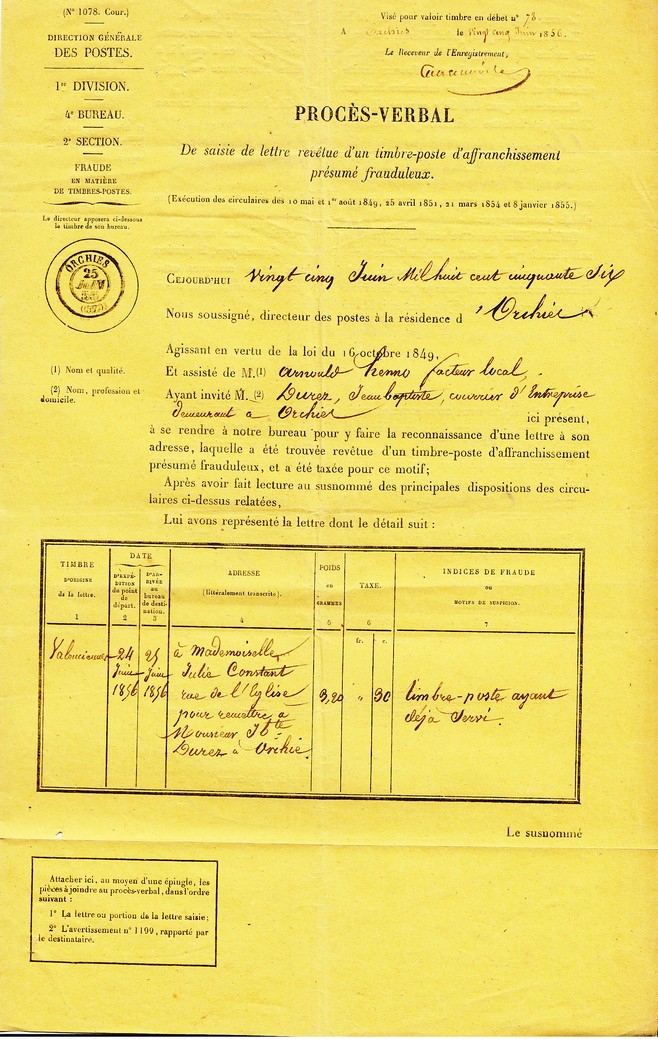
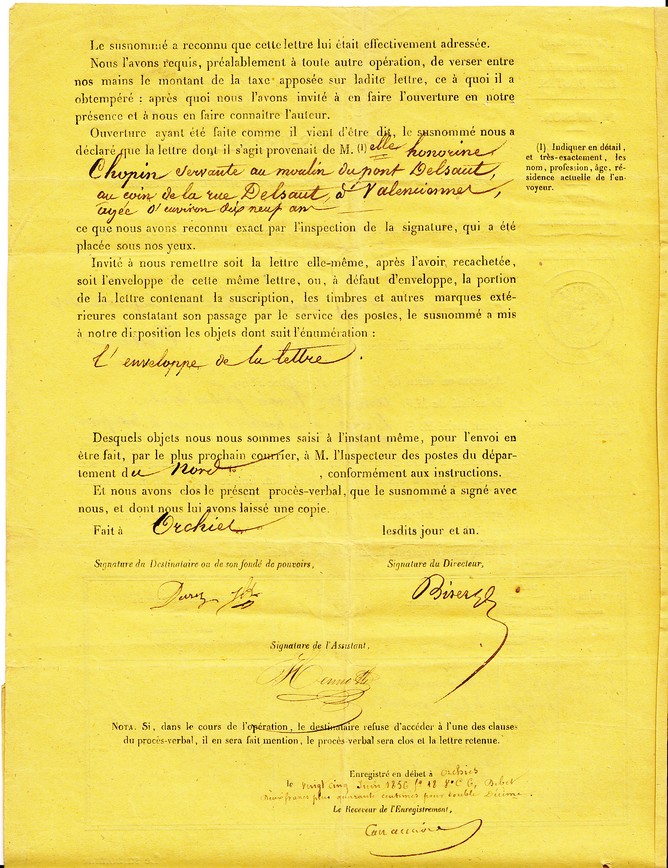

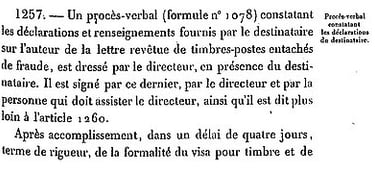
The minutes were signed by the Director, the addressee (or their representative), and an assistant. This assistant was required to be sworn in and, in all cases, had to be a member of the Postal Administration.
The minutes also reveal that the sender of the letter, Honorine Chopin, resided in VALENCIENNES.
The documents in the file were then forwarded to the postal inspector of the department where the letter originated.
This marks the conclusion of the postal procedure and the beginning of the criminal process.
Through the Departmental Postal Inspector, the Administration will file a complaint with the Imperial Prosecutor of the District of VALENCIENNES, to which VALENCIENNES belongs.
This complaint has been submitted using the attached document.
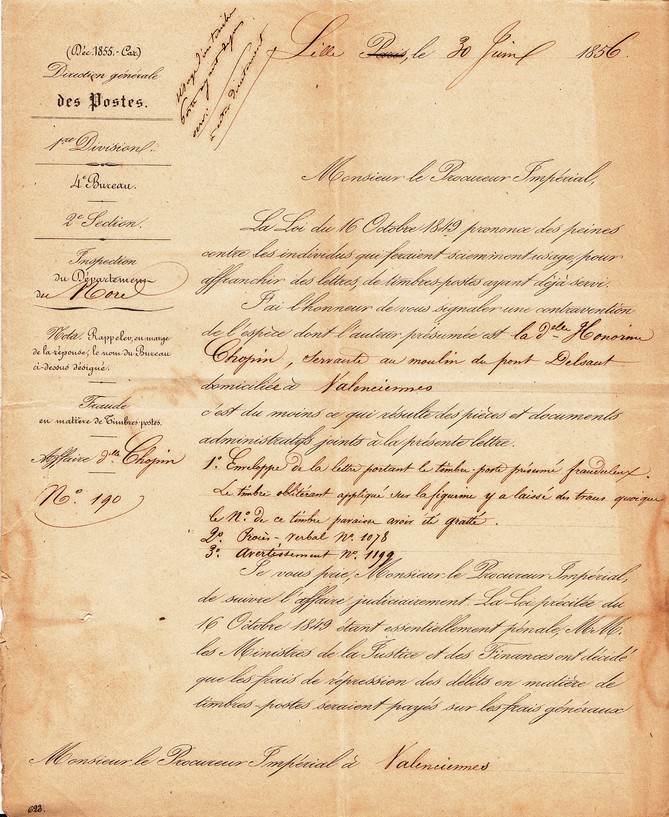
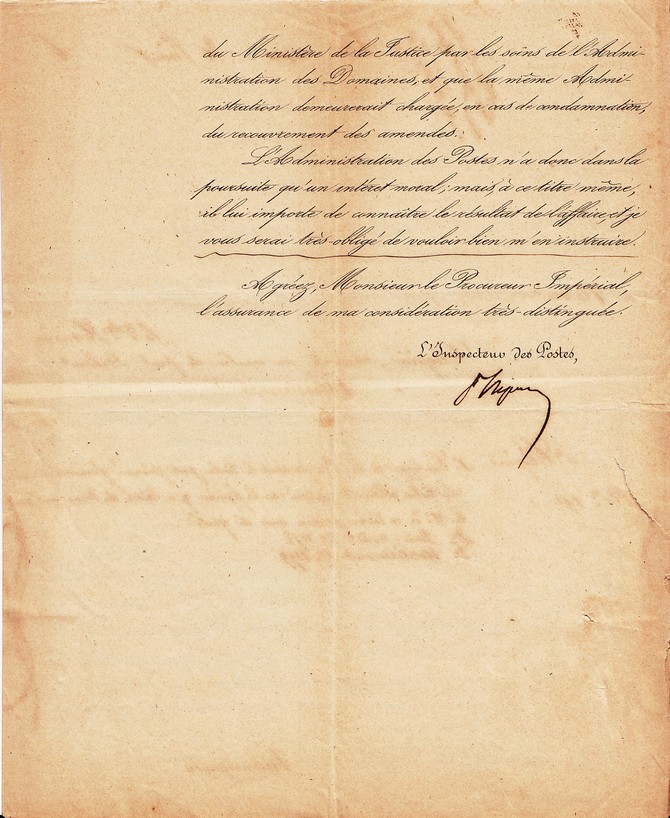
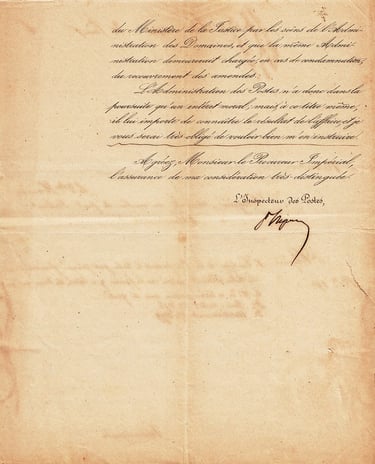
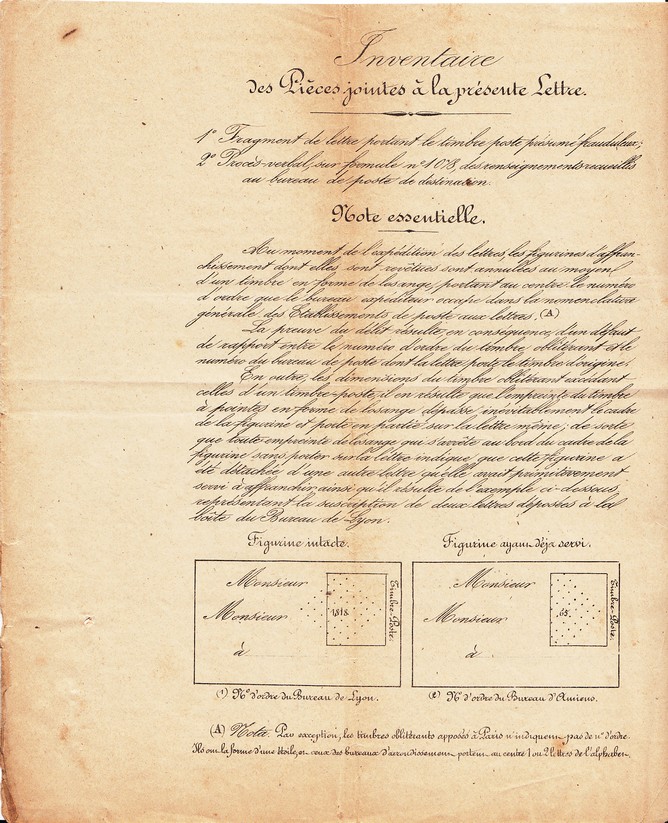
Honorine Chopin was summoned and questioned at the VALENCIENNES police station on 4 July 1856. She admitted to writing the letter and affixing the postage stamp but denied knowingly using a previously cancelled stamp. She stated:
"[...] but this stamp could not have been cancelled. I had bought it along with several others, which I kept in my trunk. This was the last one I had left. I admit that I accidentally stepped on it one day while taking some papers out of my suitcase, and it fell on the floor [...]".
A month after the letter was sent, Honorine Chopin appeared before the Valenciennes Magistrates' Court. She was found guilty of using a previously used postage stamp and was sentenced to pay a fine of 7.25 francs, along with legal costs.
English translation:
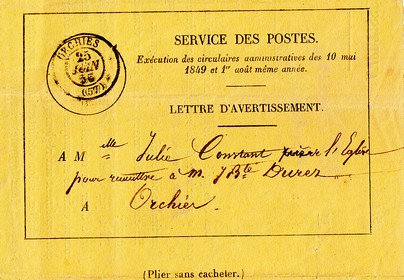
A notification letter (Form No. 1199) shall immediately be sent to the addressee, requesting that they come to the post office.
English translation:
1257. An official report (Form No. 1078), recording the statements and information provided by the addressee concerning the sender of a letter bearing postage stamps involved in fraud, shall be drawn up by the postmaster in the presence of the addressee.
The report shall be signed by the addressee, the postmaster, and the person assisting the postmaster, as specified below in Article 1260.
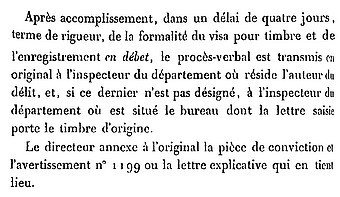
Within a strict period of four days following completion of the formalities relating to the examination of the stamp and registration of the offence, the original report shall be forwarded to the departmental inspector responsible for the area in which the offender resides.
If the offender's place of residence is unknown, the report shall be forwarded to the inspector of the department in which the post office whose originating postmark appears on the seized letter is located.
The postmaster shall attach to the original report the physical evidence, together with Notice No. 1199 or the explanatory letter replacing it.
English translation:
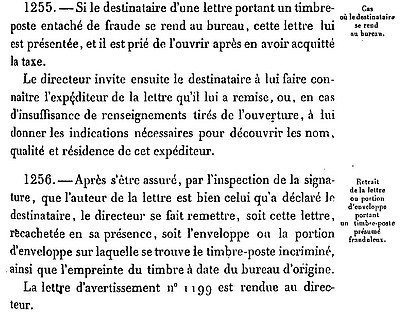
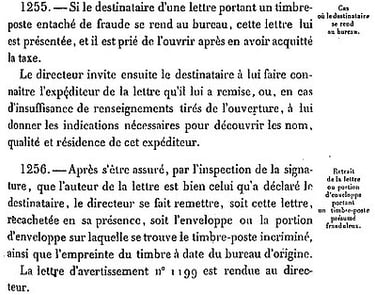
1255. If the addressee of a letter bearing a postage stamp involved in fraud comes to the post office, the letter shall be presented to them, and they shall be asked to open it after paying the postage due.
The postmaster shall then ask the addressee to identify the sender of the letter delivered to them or, if the information obtained from opening the letter is insufficient, to provide the details necessary to establish the sender's name, occupation or status, and place of residence.
1256. After verifying, by examining the signature, that the author of the letter is indeed the person identified by the addressee, the postmaster shall require the addressee to hand over either the letter, placed in a new envelope in their presence, or the portion of the original envelope bearing the postage stamp suspected of fraud, together with the impression of the dated postmark of the office of origin.
Notice No. 1199 shall be returned to the postmaster.
In this case, we are in a rather special situation, as we are dealing with a letter addressed to one person to be delivered to another. The Post Office has nevertheless taken this into account.
A notification letter was sent to the addressee on 25 June, inviting them to visit the post office to identify the letter. The secrecy of correspondence was considered sacred, and the Post Office was not permitted to open letters except under specific conditions.
Furthermore, this was merely an invitation, not a summons.
English translation:
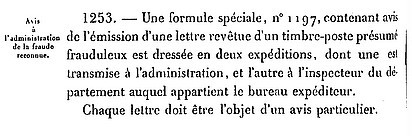
1253. A special form (No. 1197), notifying the dispatch of a letter bearing a postage stamp suspected of fraud, shall be prepared in duplicate. One copy shall be forwarded to the Postal Administration, and the other to the inspector of the department in which the post office of origin is located.
A separate notification shall be prepared for each letter.
English translation:
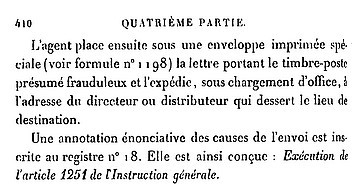
The postal employee shall then place the letter bearing the postage stamp suspected of fraud in a specially printed envelope (see Form No. 1198) and forward it, as an officially registered letter, to the postmaster or postal distributor responsible for the place of destination.
An entry stating the reason for this dispatch shall be made in Register No. 18, using the following wording:
English translation:
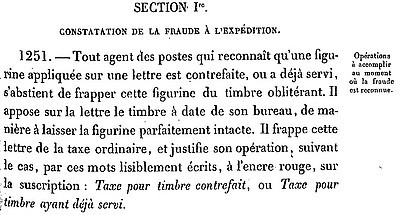
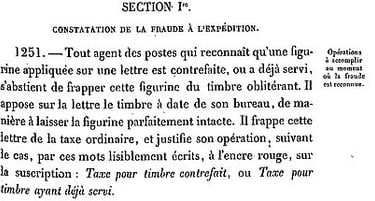
1251. Any postal employee who discovers that a postage stamp affixed to a letter is counterfeit or has already been used shall refrain from applying the cancelling handstamp to that stamp.
Instead, the employee shall apply the dated postmark of their post office to the letter, taking care to leave the postage stamp completely untouched.
The employee shall then charge the letter the ordinary postage due and justify this action, as appropriate, by writing legibly in red ink on the address side of the letter:
“Postage due on account of a counterfeit stamp”
or
“Postage due on account of a previously used stamp.”
More Postal Stories to explore


Chargé letters 1854-1876


